Know Exactly What to Say.
Word-for-word lesson scripts for every skill, so you can stay the teacher — without hours of prepping or wondering what to teach next.
Completed competencies auto-track in your progress dashboard
› "Today we're learning fractions. Hold up the pizza…"
› "Ask: 'If we cut it into 4 pieces and eat 1…'"
› "Now open the worksheet. Problem 1 says…"
★★★★★"This saved me so much time, excellent sheets"— Verified homeschool parent
You just pulled your kid out of school. Now what?
Two things are probably keeping you up: what to actually teach, and whether you're keeping any real record of it.
You don't need a teaching degree, and you don't need a perfect system on day one. You just need the right words for today's lesson — and a real, organized record of what's been covered, not just a feeling that you're "probably doing enough."
Why Copy-Pasting Random AI Prompts Doesn't Work
Four Clicks to a Complete Lesson
Pick Your Grade
Choose from Kindergarten through 8th grade.
Choose a Subject
Math, Reading, Writing or History.
Select a Competency
Pick a standards-aligned competency like 3.NF.1 — Fractions as Part of Whole.
Pick Your Situation
15-minute emergency, 45-min lesson, struggling learner, worksheet, or quiz.
Not suggestions. The actual words.
Every lesson arrives as a minute-by-minute script — what to say, what they'll probably say back, and what to do when they get it wrong. Here's a real one.
3rd Grade Math · 3.NF.1
Fractions as Part of a Whole
0:00 – 0:03
Hook
“Today we're learning about one of the most useful math ideas ever invented — fractions. You use them every day without even knowing it. Ready?”
If they say math is boring: “Fair enough. But here's the deal — by the end of this, you'll be able to split anything fairly. Cookies included.”
0:03 – 0:10
Part 1 — What is a fraction?
Take a real snack (a tortilla, an apple, a sheet of paper) and cut or fold it into 4 equal pieces while they watch.
“Watch what I'm doing. I'm cutting this into four pieces — and look, every piece is the same size. That word matters: equal. If we eat one slice, how much of the whole thing did we eat?”
Expected answer: “One piece” or “a quarter.” Either is a win — build from it.
“Exactly — one piece out of four equal parts. We write that like this: 1/4. The bottom number tells you how many equal parts the whole was cut into. The top number tells you how many of those parts we're talking about.”
Memory trick to say out loud: “The number Down below is how many pieces we Divided into. D for down, D for divided.”
“Now here's a trick question. If I cut this into four pieces but one is giant and three are tiny — is that one-fourth? … Nope. Fractions only work when the parts are equal.”
0:10 – 0:22
Part 2 — Fraction strips
Cut 5 paper strips the same length. Fold them into halves, thirds, fourths, sixths, and eighths. Label each section together.
“Line up the halves strip and the fourths strip. Which piece is bigger — 1/2 or 1/4?”
If they say 1/4 (very common): “Great guess — four sounds bigger than two, right? But look at the strips. The more pieces we cut the whole into, the smaller each piece gets. More pieces, smaller slices.”
“So which would you rather have — 1/2 of a candy bar or 1/8? Show me on the strips why.”
0:22 – 0:32
Part 3 — Reading and writing fractions
Draw a shape split into 6 parts with 2 shaded. Then give the reverse: ask them to draw 3/5. Five problems total, alternating both directions.
“Tell me the fraction for what's shaded — and say it out loud like a sentence: two out of six equal parts.”
Encouraging phrases to use: “That's exactly how a mathematician would say it.” · “You caught the equal-parts rule on your own.”
0:32 – 0:45
Part 4 & 5 — Real world + wrap-up
“Let's hunt for fractions in the house. Look at the clock — a quarter past means a quarter of the hour is gone. Find me three more: in a recipe, on a ruler, anywhere.”
“Last thing. Teach it back to me. What does the bottom number mean? What has to be true about the parts?”
Mastery check: They can name numerator/denominator, explain equal parts, and compare 1/2 vs 1/4 correctly. If any piece is shaky, re-run Part 2 tomorrow with food instead of paper.
Same depth for every competency, K–8 — and for quizzes, worksheets and struggling-learner versions too.
See a sample lesson — no accountEverything You Need to Teach With Confidence
Print Worksheets Without the Pinterest Rabbit Hole
Ready-to-print worksheets with answer keys, already matched to exactly what your child is learning — no 40-minute search for 'close enough.'
Know What's Been Covered, Without a Spreadsheet
Tracking updates automatically as you teach — see real progress week by week, with nothing to remember to update yourself.
Have Real Proof, Not Just a Feeling You're Doing Enough
Upload a quick photo of completed work and build a timestamped record you can actually point to — for your own peace of mind, or anyone who asks.
Always Know Exactly Where Your Child Stands
See exactly which competencies your child has mastered and what's coming next — no more guessing if today was 'enough.'
Teach Siblings Together, Without Doubling Your Work
Teach kids at different grade levels at the same time, with lessons adapted for each — one sitting, not two separate lesson plans.
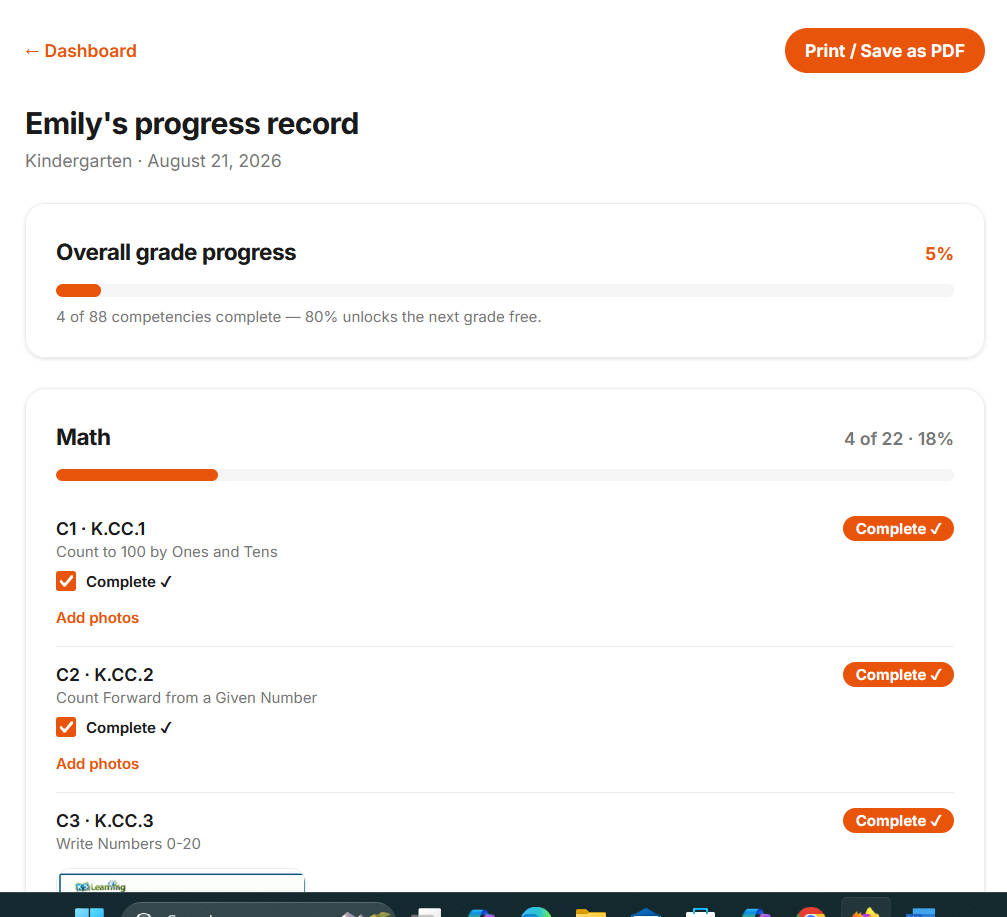
See exactly what your child has covered — and prove it, with photos.
Track every competency
Overall progress, per-subject breakdown, and 80% unlocks the next grade free.
Add real proof of work
Attach photos of finished worksheets to any competency — before or after marking it complete.
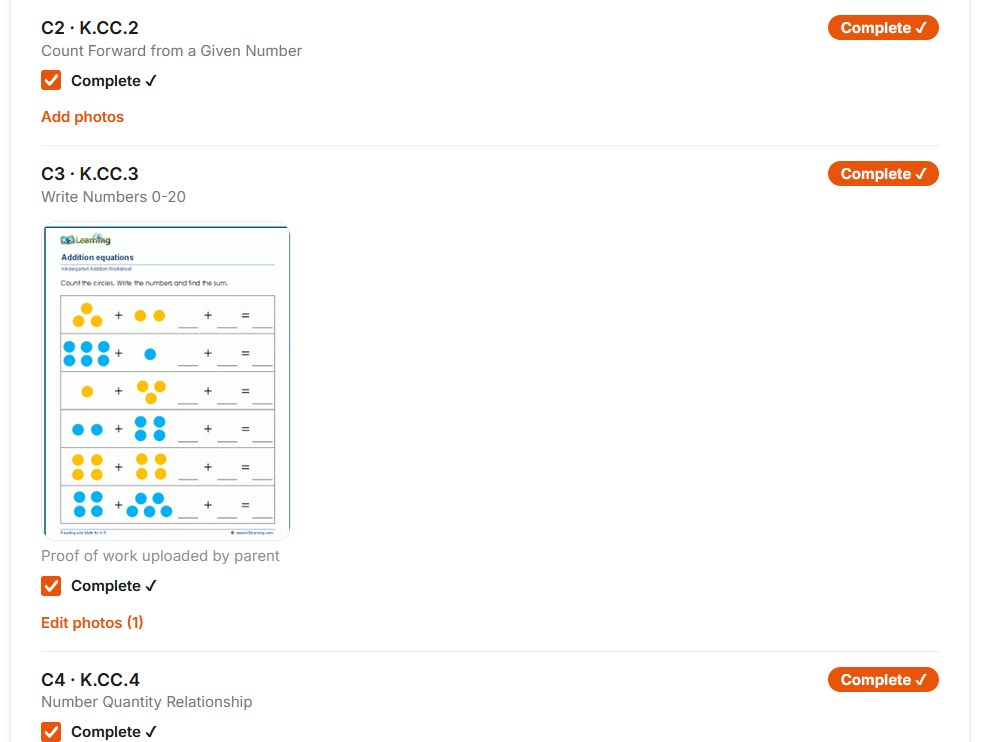
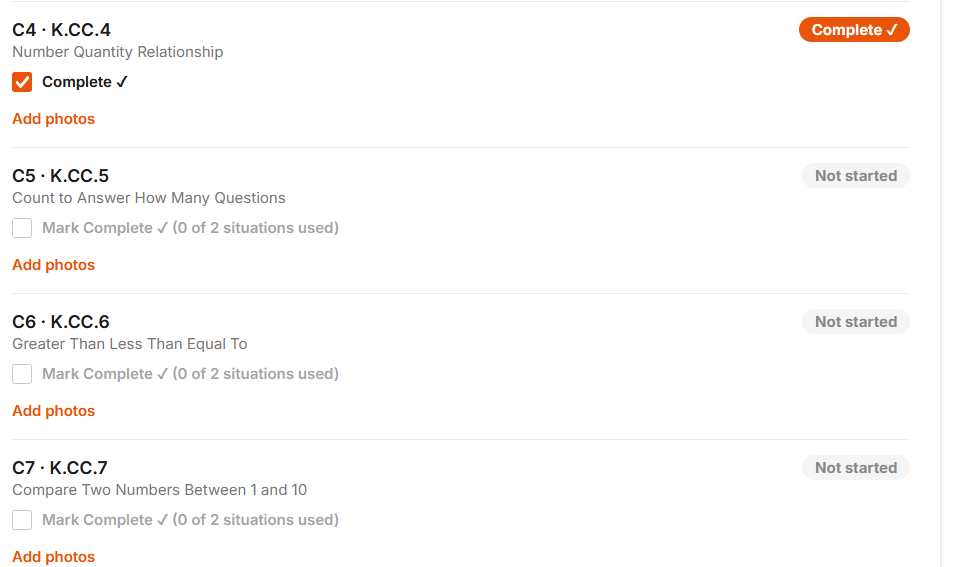
Real screenshots from a test account — sample data, not a real child.
What a Homeschool Morning Looks Like With PromptReady
You open PromptReady. Click 3rd Grade → Math → Fractions → 45-minute lesson. A complete word-for-word lesson script appears. You're ready to teach before your coffee gets cold.
Your child is struggling with fractions. Click Struggling Learner. A completely different approach appears — slower pace, physical manipulatives, different examples. Five minutes later they get it.
Lesson done. Mark it done in your tracker — your portfolio updates as you go. Upload a photo of their worksheet. State compliance tracker moves forward.
Simple, Honest Pricing
Free
- 4 lessons per month
- One grade of your choice, locked in — any competency, any situation
- No credit card required
Want to try it first? See a sample lesson — no account needed.
Basic
or $97.99/year — save over 18%
How it works: copy prompt into Claude (free) → lesson appears
- Unlimited lesson prompts
- 1 child locked to their current grade
- All 4 subjects for that grade — Math, Reading, Writing, History
- Competency tracking built in
- Proof of work photo uploads
- Copy prompts into Claude
- Add additional grades for $4/month each
- Complete a grade's competencies to unlock the next grade
Premium
- Everything in Basic
- All grades K-8 unlocked for up to 5 children
- AI generates complete lessons instantly in the app — no copy/paste needed
- State compliance dashboard
- Full lesson history and portfolio export
Free and Basic available now as prompt generators. Premium — full AI platform — launching soon.
Questions Parents Ask
Built by a Homeschool Parent, for Homeschool Parents

A month before I started PromptReady, I didn't even know what a "prompt" was. I'm a homeschool parent, not a tech person — but like a lot of you, I found myself typing things into AI and getting generic, unhelpful results. Nothing that felt like it was actually built for my kid, my grade, the right competencies.
So I started writing better prompts myself, mapped to real standards, with real teaching techniques built in. It worked so much better that I figured other homeschool parents would want the same thing — without having to become AI experts themselves.
That's PromptReady. Built by a homeschool parent, for homeschool parents.
— Francisco, Founder
PromptReady
Start Teaching With Confidence Today
Join homeschool families who stopped guessing and started teaching.
Build Your Free AccountFree forever plan available · No credit card required · Cancel anytime